

 | |  | |  | |  | |  | |  | |  | |  |
 | |  | |  | |  | |  | |  | |  |
| CHOENG KLAT (เชิงกลัด) |
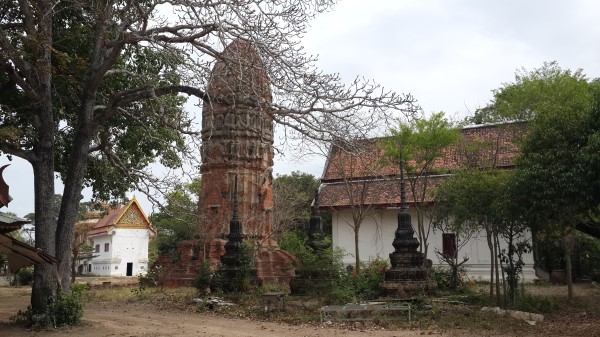
| Choeng Klat is situated in Bang Rajan District of Sing Buri Province, along the Noi River; a waterway known before as Khlong Phraek Sri Racha and likely a stretch of the main river in the Ayutthaya Era. On the premises of Wat Phra Prang in Choeng Klat stands a Khmer-styled stupa built in the Early Ayutthaya style. It is presumed that the prang was constructed in the reign of King Narai (reign 1656-1688). The prang is around 15 m high, having a short base and a hallowed chamber, which walls once featured mural paintings. To the south-west, there is an old praying hall also in the Early Ayutthaya style, with a lion-figured wood-carved gable and eaves brackets. The temple was registered as an ancient monument on 8 March 1935. The presence of a temple mound suggests that Choeng Klat was once an important location. |
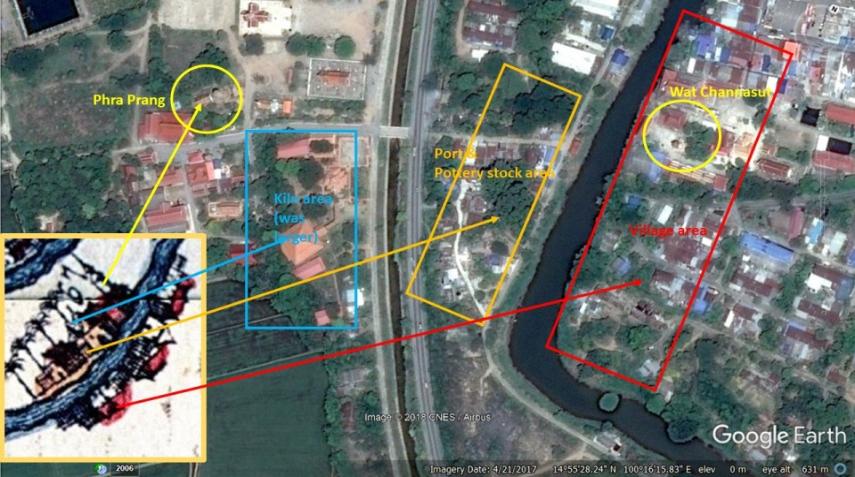
| Chai Nat on Valentyn’s map (1726) Choeng Klat was mentioned on Valentyn’s map "Groote Siamse Rievier Me-Nam Of Te Moeder Der Wateren In haren loop met de vallende Spruyten Verbeeld" published in his work "Oud en Nieuw Oost-Indiën" Volume 3, Part 2, Book 6, Chapter 1. The location is indicated as "Tioen Klat" and features a pen drawing of the village. The drawing seems to show four particular areas. The first area shows Wat Phra Prang and indicates Choeng Klat must have been an important town as it features a prang. The second area seems to show kilns and their ventilation shafts. The third area looks like a boat landing and storage rooms for the kiln products on the west bank of the Noi River, while the fourth area on the opposite bank would have been the local village, with the white structure in the middle and opposite Wat Phra Prang, likely being the still existing Wat Channa Sut. |
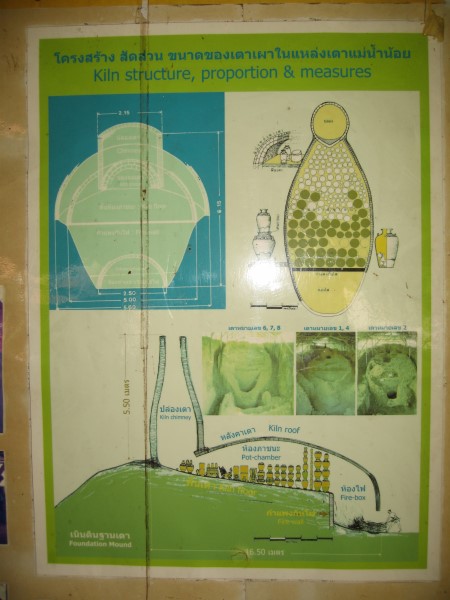
| Maenam Noi Kiln Site The Mae Nam Noi ceramic manufacturing cluster is the largest among all ancient ceramic kiln sites in the central part of Thailand which flourished during the Ayutthaya Period from the 15th till the 18th century AD. The cluster is known as the Mae Nam Noi kilns (referring to the river), the Channa Sut kilns (referring to the area) or the Wat Phra Prang kilns (referring to the monastery on its location). Choeng Klat stood likely under Phraek Sri Racha (San Buri). Excavation of the site was done over 1988-89 when four kilns were dug up. The technology and characteristics of the Bang Rachan kilns were similar to the Sawankhalok kilns of Si Satchanalai and the Thuriang Kilns of Sukothai. It is therefore believed that in the late 14th century or early 15th century some local potters of the northern towns were brought or forcibly taken to Ayutthaya and relocated to the Bang Rachan area. The original site must have been covered about two square kilometers or 200 hectares on the west bank of the Noi River and it is assumed that once there were hundreds of kilns here. Today there are only 6 kilns left on an area of 32 Are (0.79 Acres). All excavated kilns face the Noi River in the eastern direction. The brick kilns were of the cross-draft type with the ventilation stack slanting upwards. The kiln was divided into three sections: a chimney, a pottery room, and a fire box. Because the middle part looked like a roofed boat (Ruea Prathun), it was also called as a "roofed boat kiln" (Tao Prathun). [1] The kilns were built on the mounds that occurred from an accumulation of ceramics fragments, broken bricks, ashes, and laterites. The arrangement of each kiln was universal. One mound was built for each kiln and the mound slope was slanted towards the front of each kiln. The roof of the kiln is intended to be the firewall and was built using bricks, then covered with an additional layer of broken bricks and laterites, most likely to maintain the high temperatures needed for firing. This kind of kiln was used to produce both glazed and unglazed ceramics but the glaze from these kilns was of a lower quality. They also produced clay water pipes. To mass produce the ceramics, they used a flat plate or fragments of bottom rings of ceramics as the stacking supports dividing each ceramic. The bottom of the firing chamber of the kiln was made from brick then coated with soil. The floor was then sloped at about a 10 to 15-degree angle, from the firing chamber to the chimney. The height of the fire trench in the fire box was about 2-2.10 meters. |
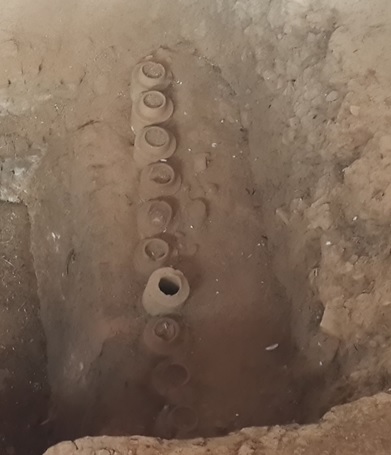
| The dimensions of each kiln are 14-16 meters in length and about 5-5.60 meters in width. Each kiln and chimney were oval shaped. Due to the high temperatures needed to fire these ceramics, the insides of the kilns were melted in some places, most commonly in the fire trenches and chimneys. Fragments of the fuel found in the fire trenches and used to fire the ceramics were identified as wood. The kiln structure shows the high technology for mass production but the focus is not on a high-quality ceramic. [2] Production periods The Bang Rachan ceramic production history can be divided into three periods based on the study of the finds from shipwrecks. The earliest period covers the 15th until the 16th centuries and the type of wares found, were brown-glazed and unglazed ovoid jars in different sizes with four handles, called "Hai Si Hu"; found in the shipwrecks at Ko Khram (c. 1450 - 1487), the "Royal Nanhai" (c. 1450 - 1487) off the eastern Malaysian Coast and the "Nanyang" (c. 1425-1450) near Pulau Pemanggil. The Middle period comprises mostly the 16th century and wares recovered consisted of brown-glazed and unglazed jars in several sizes again with four handles, brown-glazed jars with flared rim and four handles, unglazed jars with four handles, brown-glazed and unglazed bottles (without handle), unglazed with two handles bottles, brown-glazed basins, brown-glazed jarlets, mortars and cups, and unglazed lids; found in shipwrecks near Ko Samui (c. 1658-1857), Brunei, Lena Shoal (c. 1488 - 1505), Ko Si Chang III (c. 1450 - 1497), Klang-Ao (1500 - 1530) and Ko Kra (16th C). The last period covers the 17th till the 18th century and is associated with Kraak ware, a type of Chinese export porcelain produced mainly in the Wanli reign (1573–1619) and European wares from the 18th century. Production in Bang Rajan ended with the Burmese invasion of 1766 and the fall of Ayutthaya in 1767. Wares recovered consisted of brown-glazed jars and unglazed of different sizes with four handles, unglazed jars (without handle), unglazed basins, mortars, vases and bottles with two ring handles; found in shipwrecks near Pattaya (c. 1558-1657), Singtai, Don Hai, Ko Kradat (c. 1522-1566), Ko Si Chang I (c. 1573-1619), Hoi An (c. 1488-1505, Vietnam), St. Helena (Witte Leeuw, 1613). In this period the Maenam Noi kilns produced also terracotta water pipes which were used for the waterworks at the Rachaniwet Palace in Lopburi and the Grand Palace in Ayutthaya. Remains of those pipes can be found in kiln No 1. |
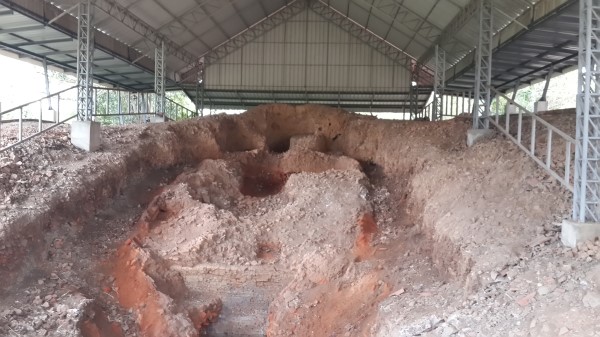
| Kiln No 2 was excavated in 1988-89. It was a cross-draft kiln with an arch-top roof of 5.60 meters wide and 14 meters long. It was called "Tao Pratoon"(boat roof). It was a very large kiln, built on a mound and having a chimney on the top. The floor of the fire chamber was tilted to the fire box. [Ref: Board in situ] |
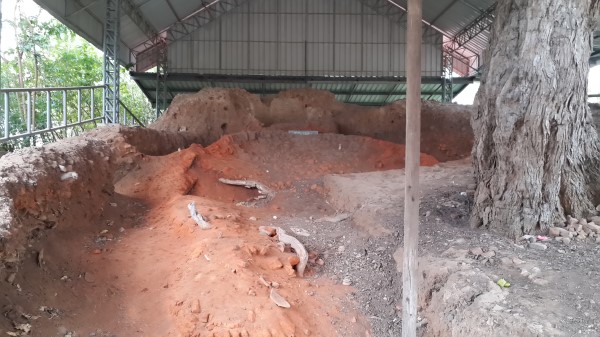
| Kiln No 3 was excavated in 1994. It was a cross-draft kiln with an arch-top roof of 5.60 meters wide and 14 meters long. It was called "Tao Pratoon"(boat roof). It was a very large kiln, built on a mound and having a chimney on the top. The floor of the fire chamber was tilted to the fire box. There is a large tamarind tree growing in the middle of the kiln ruins. [Ref: Board in situ] |
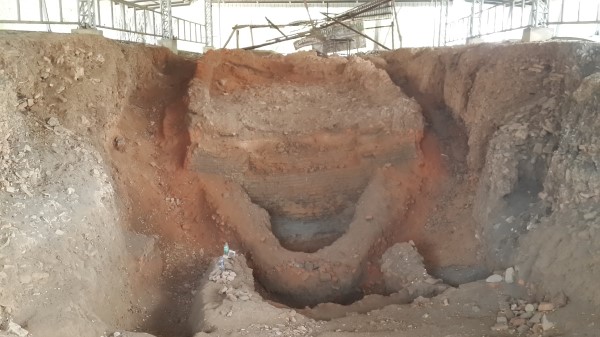
| Kiln No 4 was not excavated. Kiln No 6 was excavated in 1994. It was a cross-draft kiln with an arch-top roof of 5.30 meters wide and 14.40 meters long. It was called "Tao Pratoon"(boat roof). It was a very large kiln, built on a mound and having a chimney on the top. The floor of the fire chamber was tilted to the fire box. Excavations found three superimposing kilns built on the mound and it is assumed that the inner kiln was built in place of the former destroyed ones. [Ref: Board in situ] |
| Export It is believed that the Maenam Noi kilns were the major supplier of stoneware storage containers for Ayutthaya and the maritime trade. They were also exported to the Southeast Asian market and even as far as overseas to Philippines, Japan, Australia, Africa and Portugal. A large number of storage jars of the Noi River kiln site was found at wreck-sites in several parts of the world as well as in almost all the wrecks in the Gulf of Siam, in Malaysian and Indonesian waters. The main ceramic produced for export were brown glaze and unglazed stoneware storage jars of various types and sizes and especially, small jars with reduction iron glaze. Other type and sizes of ovoid bottles, wide mouth globular jars, large basins, water bowls, pear-shaped bottles with a flared mouth (spirit bottle). water jugs, mortars, stoves, architectural fittings and decorative items, floor tiles, roof tiles, drainage pipes, cannon balls, figures of divinity, mythic animals and clay dolls for mystic functions, were produced on this site. The famous four-lug jars were also found in maritime communities in Africa, at shipwreck sites in Australian water and on-land sites in Japan. References: 1. Atthasit Sukkham - Variability in Ceramics of the Bang Rachan (Mae Nam Noi) Kilns, Singburi, Thailand - Southeast Asian Ceramics Museum, Bangkok University. 2. Wilaikaew, Jaruk (1990) - Mae Nam Noi Kilns, Volume II. Bangkok: Office of Archaeology, Fine Arts Department of Thailand – page 77. |
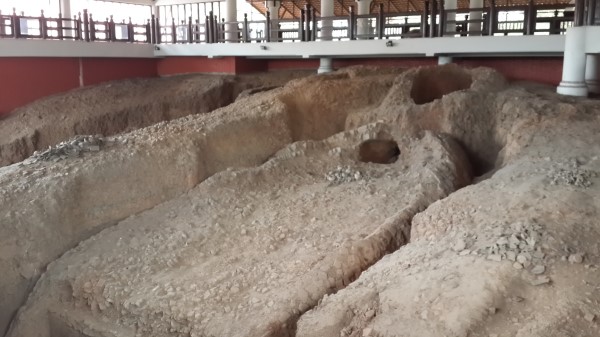
| Description of the excavated kilns Kiln No 1 and 5 |
| (Detail of Valentyn's map projected on a Google Earth's map) |